


2026 Honda Accord vs. 2026 Toyota Camry
Choosing between two of the best-selling midsize sedans on the market isn’t easy, especially when both have earned their reputations for good reason. If you’re cross-shopping the 2026 Honda Accord vs. 2026 Toyota Camry, you’re looking at two vehicles that share a lot on paper but diverge once you’re behind the wheel every day. We put together this comparison to help Southern Illinois drivers sort through the specs and figure out which sedan actually fits their routine. You can also browse our new vehicles while you read.
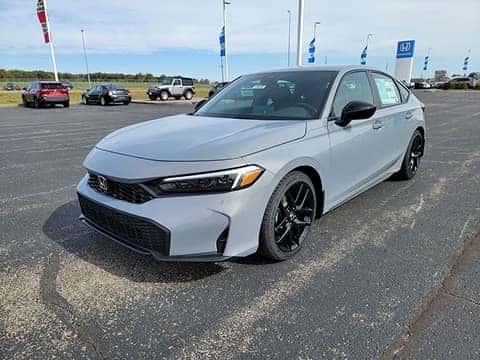
2026 Honda Accord vs. 2026 Toyota Camry: Overview for Midsize Sedan Shoppers
Both the Accord and Camry have spent decades building loyal followings, and the 2026 versions keep that going with updated trims, new safety tech, and improved hybrid systems. The biggest structural difference comes down to powertrain philosophy. Honda still sells a gas-only option alongside its hybrids, while Toyota has gone hybrid across the entire Camry lineup. That single decision shapes pricing and fuel economy, and it even determines which trims come with AWD.
| Model / Trim | Engine | Drivetrain | Horsepower / Torque | Fuel Economy (City/Hwy) | Cargo Volume |
|---|---|---|---|---|---|
| Accord LX/SE | Turbo 1.5L I4 | FWD | 192 hp / 192 lb-ft | 29/37 (LX), 28/36 (SE) | 16.7 cu-ft |
| Accord Sport Hybrid | 2.0L I4 hybrid | FWD | 204 hp / 247 lb-ft | 46/41 | 16.7 cu-ft |
| Accord EX-L Hybrid | 2.0L I4 hybrid | FWD | 204 hp / 247 lb-ft | up to 51/44 | 16.7 cu-ft |
| Camry LE Hybrid | 2.5L I4 hybrid | FWD or AWD | 225 hp FWD / 232 hp AWD | up to 52/49 | 15.1 cu-ft |
| Camry SE/XLE/XSE Hybrid | 2.5L I4 hybrid | FWD or AWD | 225 hp FWD / 232 hp AWD | up to 47/45 | 15.1 cu-ft |
Powertrain Choices and Fuel Economy
Honda keeps a turbocharged gas engine in its entry trims for buyers who want lower upfront costs. Toyota, meanwhile, has committed every 2026 Camry trim to its fifth-generation hybrid system.
Accord Gas Trims (LX, SE) vs. Camry Hybrid Lineup
The Accord LX and SE trims use a turbocharged 1.5-liter four-cylinder producing 192 hp and 192 lb-ft, paired with a CVT and FWD. Since every Camry is hybrid for 2026, there’s no direct gas-to-gas matchup here. The Camry LE reaches up to 52/49/51 mpg, making it the mileage leader if you never plan to step up to an Accord Hybrid trim.
Accord Hybrid Trims (Sport, EX-L, Sport-L, Touring) vs. Camry Hybrid
The Accord Hybrid uses a 2.0-liter non-turbo four-cylinder. Sport Hybrid produces 204 hp and 247 lb-ft at 46/41/44 mpg, while EX-L Hybrid reaches as high as 51/44/48 mpg. Every Accord trim, gas or hybrid, is FWD only; Honda doesn’t offer AWD on the Accord at all. Toyota offers AWD across every Camry trim, which matters if you deal with Southern Illinois winter weather and want all-wheel traction.
Real-World MPG and Efficiency Comparison
The real-world efficiency gap between the Accord Hybrid and Camry Hybrid is negligible in daily driving. Where the Accord pulls ahead is in how it feels: it’s notably quieter under acceleration. Car and Driver’s independent testing backs this up, clocking the Accord Hybrid at 6.7 seconds to 60 mph, compared to 6.8 seconds for the Camry XSE AWD and 7.0 seconds for the Camry FWD Nightshade Edition. The Accord Hybrid’s fuel tank measures 12.8 gallons, close to the Camry’s 13-gallon tank, and Honda equips every Accord trim with standard cap-less fueling.
If you’re weighing price alongside these numbers, financing terms matter too. You can apply for financing before you ever step into a showroom.
Passenger Space and Everyday Practicality
The Accord offers 105.7 cubic feet of passenger volume compared to the Camry’s 99.9 cubic feet. It’s also 2.2 inches longer and nearly an inch wider overall, though it actually weighs about 27 pounds more than the Camry despite the larger footprint.
Front and Rear Legroom
Front legroom is close (42.3 inches in the Accord versus 42.1 in the Camry), but the rear seat is where the Accord pulls ahead. It offers 40.8 inches of rear legroom to the Camry’s 38 inches, nearly three extra inches that adult passengers will feel on a longer drive.
Shoulder room goes the Accord’s way in both rows as well, 57.9 versus 57.7 up front and 56.5 versus 55.7 in back, which makes three across the back seat easier to live with. The Accord also leads on front headroom at 39.5 inches to the Camry’s 38.3 without a moonroof, while rear headroom is effectively a wash at 37.3 versus 37.6. Add it up and the Accord gives passengers more room to stretch out where it counts most.
Ride Quality and Highway Refinement
Both sedans deliver a comfortable ride, and the differences here are more about character than capability. The Accord has an edge in steering feel and offers a more upscale cabin, while the Camry earns praise for comfortable seating and its tech offerings. Overall ride quality is similar between the two, so this comparison often comes down to personal preference behind the wheel.
Trunk Capacity
Honda lists the Accord’s trunk at 16.7 cubic feet, against the Camry’s 15.1 cubic feet. Both sedans offer 60/40 split-folding rear seats, adding flexibility for larger items.
Technology and Safety Features
Technology has become one of the biggest differentiators in the midsize sedan class, and this is where the conversation often shifts in the Accord’s favor, at least on paper.
Infotainment and Connectivity
Every 2026 Accord trim comes standard with wireless Apple CarPlay and Android Auto and a wireless charging pad. LX and SE feature a 9-inch touchscreen, while Sport Hybrid and above step up to a 12.3-inch display with Alexa built-in, and Google built-in is available on the Touring Hybrid.
The Touring Hybrid adds Bose audio and a head-up display. The Camry starts with a smaller 8-inch screen, only stepping up to the 12.3-inch display on the XLE and XSE trims. Camry audio starts at six speakers, with an available 9-speaker JBL system and an optional 10-inch head-up display.
Honda Sensing vs. Toyota Safety Sense
Honda Sensing® comes standard across the entire Accord lineup, bundling Collision Mitigation Braking System (CMBS), Road Departure Mitigation, Adaptive Cruise Control, Lane Keeping Assist, and Traffic Sign Recognition. You can read more about how Honda Sensing technology works across our lineup. The LX is the only Accord trim without blind-spot monitoring; the SE and above add it along with rear cross-traffic monitoring.
Toyota Safety Sense 3.0 (TSS 3.0) is also standard across every Camry trim, and Toyota includes Blind Spot Monitor as standard equipment on every trim, including the base LE, which the Accord LX lacks. This is a real point in Toyota’s favor for budget-focused buyers.
On independent safety ratings, IIHS awarded the Camry its Top Safety Pick+ designation, while the Accord earned the standard Top Safety Pick. That gap comes mostly from newer pedestrian-detection testing standards rather than any real difference in crash protection, and the Accord still holds up as a safe sedan by any measure.
Trim Lineups and Overall Value
The Accord offers six trims total: two gas (LX, SE) and four hybrid (Sport Hybrid, EX-L Hybrid, Sport-L Hybrid, Touring Hybrid). The SE adds an 8-speaker audio system, power moonroof, dual-zone climate control, heated seats, a 10-way power driver’s seat, and 19-inch alloy wheels. At the top, the Touring Hybrid brings a head-up display, Bose audio, ventilated seats, and Google built-in.
The Camry sticks to five hybrid trims: LE, SE, Nightshade Edition, XLE, and XSE, with the Nightshade Edition new for 2026 and slotted between SE and XLE. LE and XLE lean toward comfort tuning, while SE and XSE get a sport-tuned suspension.
Warranty coverage is close between the two brands, with both offering a 3-year/36,000-mile basic warranty and similar scheduled maintenance coverage (Accord at 2 years/24,000 miles, Camry at 2 years/25,000 miles). Where Toyota pulls ahead is hybrid battery coverage: 10 years/150,000 miles compared to Honda’s 8 years/100,000 miles. That’s a legitimate advantage for Camry Hybrid buyers planning to keep their car for the long haul, and it’s worth factoring into your decision.
Which Sedan Fits Your Driving Needs
How and where you drive ends up deciding this more than any spec sheet. A few common scenarios below show how the two stack up.
Best for Commuters
If your daily drive is mostly stop-and-go or short trips around Marion, Herrin, or Carbondale, the Camry LE’s mpg rating of up to 52 combined makes it hard to beat for pure fuel savings. But if you want quieter acceleration and a nicer cabin during that commute, the Accord Hybrid closes the efficiency gap while delivering a smoother driving feel.
Best for Families
Families hauling kids, gear, or both will likely lean toward the Accord. The extra two inches of rear legroom and larger trunk space make a real difference on family trips, and even the LX and SE come standard with a 9-inch touchscreen, wireless Apple CarPlay, and Android Auto, so you’re not sacrificing core tech just because you picked a lower trim level.
Best for Frequent Highway Drivers
For drivers who spend a lot of time on I-57 or I-24 heading out of Southern Illinois, the Accord’s smoother ride, quieter cabin, and fuel tank as large as 14.8 gallons on the LX and SE (12.8 gallons on Hybrid trims) add up to fewer stops and a more comfortable ride over long distances. If AWD traction is your top priority for highway driving in winter conditions, though, the Camry’s AWD availability across every trim is worth serious consideration.
Explore the 2026 Honda Accord at Ike Honda
We’ve sold Hondas in Southern Illinois since 1976, and that history means we know this car inside and out. If the Accord’s extra rear legroom, standard touchscreen technology, or Honda Sensing suite sound like they fit your life, we’d encourage you to explore our Accord inventory and see the current lineup of trims and colors we have on the lot in Marion, Illinois.
Specs on a page only tell part of the story. The best way to settle the debate for yourself is to sit in both cars, and we’re happy to help you do exactly that.
Schedule Your Test Drive
As a family-owned dealership, we keep the buying process low-pressure, so you can move at your own pace and drive away confident in your decision. Stop by our location at 4407 W Deyoung St, Marion, Illinois 62959, or reach out to our team to schedule a test drive.
0 comment(s) so far on 2026 Honda Accord vs. 2026 Toyota Camry