


2026 Honda Ridgeline vs. 2026 Ford Ranger
Picking between the 2026 Honda Ridgeline & the 2026 Ford Ranger means weighing two completely different takes on what makes a good midsize truck. The Ridgeline focuses on comfort with its car-based design, while the Ranger sticks to traditional truck roots with maximum towing power in mind. We’ll break down which one might fit your life better, whether you’re hauling gear or just cruising through Marion.
Quick Comparison Overview
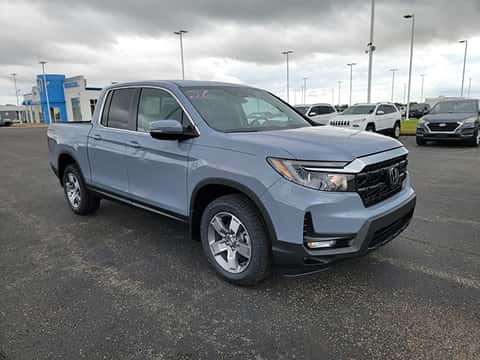
The main difference between these two trucks is that Honda targets daily drivers, while Ford focuses on traditional truck buyers. Honda’s single 3.5-liter V-6 produces 280 hp and 262 lb-ft of torque, paired with a nine-speed automatic with shift-by-wire and paddle shifters. Every Ridgeline includes Honda’s Intelligent Variable Torque Management all-wheel drive (AWD) for enhanced traction on rough roads.
Ford provides three engine choices: a standard turbo 2.3-liter four-cylinder delivering 270 hp and 310 lb-ft of torque, a twin-turbo 2.7-liter V-6 outputting 315 hp and 400 lb-ft of torque, and a twin-turbo 3.0-liter producing 405 hp and 430 lb-ft of torque in the Raptor. All versions come with a 10-speed SelectShift automatic transmission with rear-wheel drive (RWD) or four-wheel drive (4WD).
When looking at Honda Ridgeline pricing, the base Sport model starts at $40,595 compared to the Ford Ranger XL’s $35,245.
Design and Space
Honda uses unibody construction with Advanced Compatibility Engineering (ACE), while Ford sticks with a traditional body-on-frame design. The 2026 Ridgeline now offers a TrailSport-exclusive Ash Green Metallic color and the Black Edition’s contrasting black roof options.
Inside the Ridgeline, you’ll get 40.9 cubic feet to stretch out your legs in the front vs. the Ranger’s 43.2 cubic feet. While it may have less front legroom, your passengers will appreciate the Ridgeline’s class-leading 36.7-inch rear legroom, which beats the Ranger’s 34.6 inches, on Crab Orchard Lake fishing trips.
Performance and Powertrain
Honda features Variable Cylinder Management that shuts down cylinders when unneeded, plus Direct Injection for better power. The Idle-Stop system kills the engine at stoplights if you idle for over 2 seconds, which is perfect for Marion’s summer festival traffic. Testing showed the Ridgeline TrailSport hit 60 mph in 6 seconds, topped out at 111 mph, and stopped from 70 mph in 180 feet.
Ford offers more choices, so you can pick the engine power that fits your needs in Marion. The four-cylinder 4WD hits 60 mph in 6.2 seconds, the V-6 4WD manages 5.6 seconds, and the Raptor takes 5.3 seconds.
Power delivery differs significantly. Honda’s smart AWD figures out power distribution automatically, so you don’t need to worry during surprise Illinois storms. Ford’s traditional 4WD needs manual engagement but offers more control off-road. The Ridgeline drives like a Honda Pilot with a bed — smooth and car-like. On the other hand, the Ranger feels like a proper truck.
Towing and Payload Capacity
The Ridgeline maxes out at 5,000 pounds for towing with a 1,583-pound payload capacity. You’ll be able to pull small boats, pop-up campers, or utility trailers. The Ranger delivers a 7,500-pound maximum towing rating plus a payload of 1,788 pounds for the four-cylinder or 1,542 pounds for the V-6.
That 2,500-pound gap means you can haul bigger boats to Rend Lake or heavy equipment for construction work that would exceed Honda’s limits. But you may not need to tow near these maximums.
The Ridgeline counters with unique features, such as a lockable In-Bed Trunk for secure storage and dual-action tailgate for easier loading. Ford offers towing technology for trailer backing and monitoring. Choose based on whether you need maximum capability or prefer clever features with adequate towing.
Fuel Economy and Efficiency
The Ridgeline uses cylinder deactivation and auto start-stop to conserve gas, achieving 18 mpg city/24 mpg highway for most versions. Due to rugged tires, the TrailSport gets 18 mpg city/23 mpg highway.
The Ranger’s economy varies by engine. The 2.3-liter four-cylinder delivers 21 mpg city/26 mpg highway with RWD or 19 mpg city/26 mpg highway with 4WD. The 2.7-liter V-6 manages 19 mpg city/23 mpg highway, while the Raptor’s 3.0-liter V-6 drops to 16 mpg city/18 mpg highway. While Ford is slightly more efficient overall, the Ridgeline still gets good numbers.
Safety Features and Ratings
The 2025 Ridgeline includes the full Honda Sensing safety package on every single truck. That means adaptive cruise control, lane-keeping assist, and blind-spot monitoring come standard. Honda doesn’t make you pay extra for these driver-assistance features, regardless of which model you choose.
Ford takes a tiered approach with Ranger safety. The base model is pretty simple, while XLT and higher trims include the Ford Co-Pilot360 package. This bundles precollision assist with automatic emergency braking, a blind-spot information system, a lane-keeping system, auto high-beam headlamps, and a rearview camera. Advanced technology such as 360-degree cameras, adaptive cruise control, front parking sensors, and speed sign recognition costs extra through the Technology Package.
The trucks’ different construction affects crash protection too. Honda’s unibody design with ACE body structure distributes impact forces differently than Ford’s separate body-on-frame setup. Both approaches work well in crashes, though unibody designs typically offer better protection in certain types of collisions. Both manufacturers offer trailer stability systems and collision mitigation technology to help avoid accidents.
Technology and Infotainment
On the technology front, Honda keeps it simple but effective. Every Ridgeline comes with a 9-inch touch screen that includes wireless Apple CarPlay and Android Auto. The standard audio is a seven-speaker system, with an upgraded eight-speaker setup on the Black Edition if you want better sound quality. Plus, the wireless phone connection means no more fumbling with cables every time you hop in.
Ford offers bigger screens but makes you pick options carefully. Base XL and XLT Rangers get a 10.1-inch touch screen, while the 12-inch display is optional on XLT and standard on Lariat. Audio starts with a basic six-speaker system, but you can upgrade to a 10-speaker Bang & Olufsen setup.
Daily use reveals differences in how these systems work. Honda’s setup is super intuitive; just tap and go with minimal menus to wade through. Ford’s SYNC 4 software has more bells and whistles but takes longer to learn all its features. Both support the latest smartphone technology, though Honda makes wireless connectivity standard across the board. Navigation comes built-in on Honda’s TrailSport and Black Edition, while Ford offers it through various packages. Both trucks’ digital displays can show truck-specific information, such as trailer data and off-road metrics, when properly equipped.
Which Midsize Truck Delivers the Best Value?
Honda’s Ridgeline ranks No. 1 in U.S. News’ 2025 Midsize Pickup Truck rankings, while Ford’s Ranger sits at No. 5. Choose the Ridgeline if you want SUV-like driving with a bed, decent gas mileage, loaded safety technology, and dependability. Pick the Ranger if you regularly tow heavy loads, need traditional truck capability, want engine choices, or prefer a classic truck feel. But you’ll pay more up front and need to add packages for Honda’s standard features.
If you’re curious about the Ridgeline’s comfort and capability mix, stop by Ike Honda to see if this truck fits your southern Illinois lifestyle.
0 comment(s) so far on 2026 Honda Ridgeline vs. 2026 Ford Ranger